
Table of Contents
India Nepal Relations 2026: Modi Announces $1.62 Billion Flood Recovery Package During Balendra Shah Visit
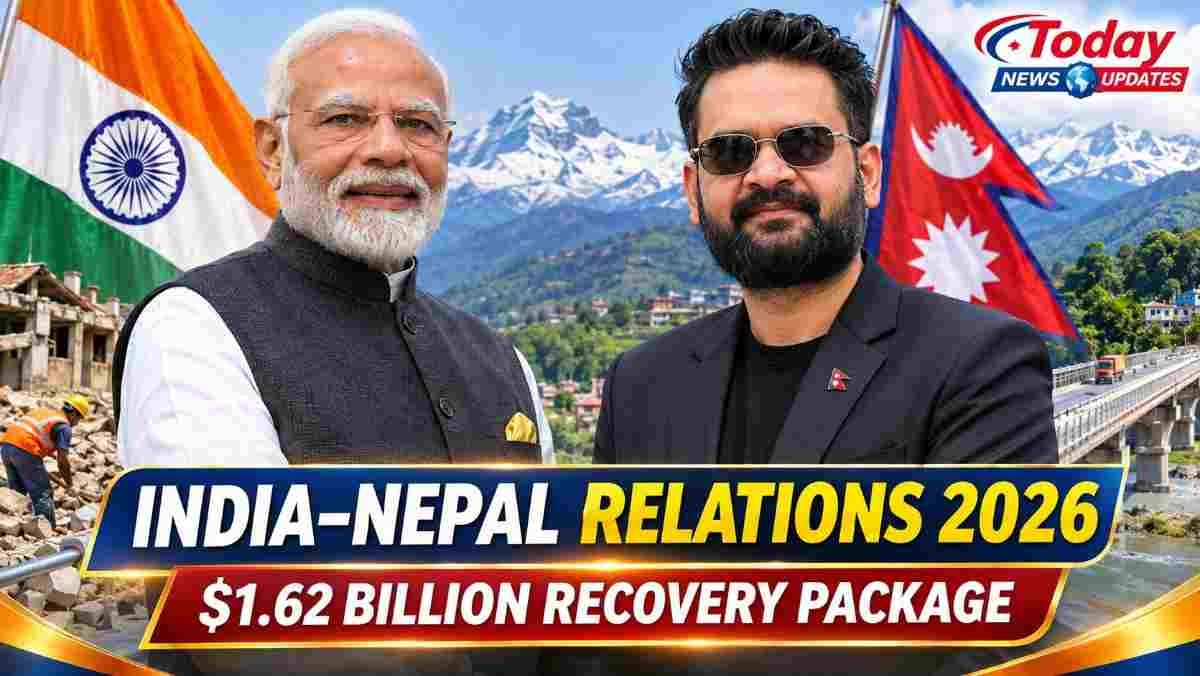
India Nepal Relations 2026 have entered a significant new phase after Prime Minister Narendra Modi announced a $1.62 billion economic assistance package for Nepal during bilateral talks with Nepalese Prime Minister Balendra Shah in New Delhi on November 23, 2026.
The announcement comes after devastating floods struck Nepal in August, damaging homes, roads, bridges, agricultural land and important energy infrastructure. The financial package aims to support reconstruction, restore essential services and strengthen long-term economic cooperation between the two neighbouring countries.
During the visit, both governments also signed agreements covering technology, healthcare, education, urban development and infrastructure, highlighting their efforts to expand bilateral cooperation beyond traditional diplomatic relations.
India Nepal Relations 2026: What Did Modi Announce?
Prime Minister Narendra Modi announced a development cooperation package worth 240 billion Nepalese rupees, equivalent to approximately $1.62 billion or Rs 15,000 crore. The package includes financial support for rebuilding infrastructure and improving Nepal’s capacity to manage future natural disasters.

According to reported details, approximately $377 million will be provided as grants for reconstruction and infrastructure development. Another $1.24 billion will be made available through a line of credit, primarily supporting energy-related projects.
A grant provides financial assistance without requiring repayment, while a line of credit allows the recipient to borrow funds under agreed conditions.
The two governments will determine specific projects and implementation arrangements through further consultations. The announcement reflects India’s continuing involvement in Nepal’s economic development and disaster recovery.
Why Does Nepal Need Such a Large Financial Package?
Nepal experienced devastating Himalayan floods in August 2026, resulting in widespread destruction across several regions. Reports indicate that approximately 1,500 people died, while more than 5,200 were reported missing following the disaster.
Thousands of families lost homes, farmland and sources of income. Floodwaters also damaged transportation networks, making it difficult for communities to access essential services. The disaster severely affected Nepal’s energy sector. More than a dozen hydropower projects sustained damage, reducing electricity generation capacity and disrupting power exports.
Nepalese authorities estimate that rebuilding damaged infrastructure and restoring economic activity will require billions of dollars.
India’s assistance is intended to support recovery while helping Nepal improve its resilience against future floods and other natural disasters.
Who Is Nepal Prime Minister Balendra Shah?
Balendra Shah, popularly known as Balen Shah, is Nepal’s Prime Minister and a former mayor of Kathmandu.
Before entering national politics, he gained public recognition as a rapper and later became known for his political involvement and urban governance initiatives. Shah assumed office in March 2026 following a period of major political change in Nepal.
His November visit marked his first bilateral foreign trip as Prime Minister, demonstrating the importance both governments attach to maintaining close diplomatic relations. During his discussions with Modi, Shah emphasised cooperation, mutual respect and opportunities for Nepal’s economic development.
He also invited the Indian Prime Minister to visit Nepal, signalling interest in continuing high-level diplomatic engagement.
India and Nepal Sign Eight Agreements to Strengthen Cooperation
Apart from financial assistance, India and Nepal signed eight memorandums of understanding covering several important sectors.
The agreements include cooperation in satellite communications, public administration, healthcare, traditional medicine, sustainable urban development, livestock and fisheries, and institutional training.
Satellite communication cooperation could improve access to technology and communication infrastructure.
Healthcare and medical cooperation may create opportunities for professional training, institutional collaboration and improved public services.
Meanwhile, urban development agreements could support Nepal’s efforts to modernise cities and strengthen municipal infrastructure.
These initiatives aim to create a broader foundation for economic and technical cooperation between the two countries.
New Ayodhya-Janakpur Train Service Strengthens Connectivity
Another important development in India Nepal Relations 2026 was the inauguration of the Saryu-Kamala Express, connecting Ayodhya in India with Janakpur in Nepal.
The service is expected to strengthen cross-border connectivity and support religious tourism between two culturally significant destinations. Ayodhya is closely associated with Lord Rama, while Janakpur holds special importance in the Ramayana tradition as the birthplace of Goddess Sita.
Improved railway connectivity could make travel more convenient for pilgrims, tourists and residents.
The leaders also advanced cooperation involving border infrastructure, hydropower and petroleum connectivity. These projects demonstrate the importance of transportation and energy networks in strengthening economic relations.
Why Are India and Nepal Relations Important?
India and Nepal share extensive historical, cultural, religious and economic connections.
Their open border supports movement between communities, while trade and employment opportunities connect businesses and families across both countries.
India remains one of Nepal’s largest trading partners and an important supplier of petroleum products and essential goods.
Energy cooperation has also become increasingly significant, with Nepal exporting hydropower-generated electricity to India.
However, bilateral relations have occasionally faced challenges involving territorial disagreements, political concerns and regional strategic competition.
Both governments are seeking to expand cooperation while addressing issues through diplomatic discussions.
What Happens Next for India Nepal Relations 2026?
The next priority will be converting financial commitments and bilateral agreements into practical projects.
Reconstruction efforts will require planning, transparent implementation and coordination between government agencies. Energy infrastructure, transportation networks and disaster preparedness are expected to remain important areas of cooperation.
Successful implementation could help Nepal recover from the floods while supporting employment, connectivity and economic activity. For India, the agreements offer an opportunity to strengthen relations with an important Himalayan neighbour.
India Nepal Relations 2026 have received fresh attention following Modi’s announcement of a $1.62 billion development package and the signing of eight cooperation agreements. The assistance represents an important commitment to Nepal’s post-flood reconstruction and long-term development. With new railway connectivity, energy cooperation and institutional partnerships, both countries are seeking to strengthen their relationship through practical economic initiatives. The long-term impact will depend on how effectively the announced projects are implemented and whether they deliver meaningful benefits to communities in both countries.